
Predictive Product Quality Analytics: Reducing Steel Manufacturing Waste with AI
Using AI to help reduce waste at a large manufacturing facility.
.png)


The Challenge
A large steel manufacturing firm was losing millions of dollars a year to product defects and waste. A steel manufacturing plant is generally divided into a hot mill, where raw materials are formed into usable slabs, and a cold mill, where steel is welded together to form coils and cleaned using various chemical solutions
In the cold mill, the welding machine that joins steel coils was having issues with certain materials during the join process, and every bad weld carried a compounding cost. First, a bad weld could create ruined products which needed to be discarded. Secondly, a bad weld required pausing the assembly line to remove the products, cut out the bad weld, and then re-weld them back together. This process was being done up to 7 times for particularly problematic products, since (certain grades of steel were harder to join than others). Product waste averaged 10%, totaling millions of dollars of waste over the year.
The causes were varied and often opaque. Certain grades of steel caused issues, some times of the day were worse than others, and sometimes slabs came down the assembly line "crooked" (camber and centerline). Sometimes components of the machines went bad without operators knowing. In one instance, despite IoT information being recorded at millisecond intervals, a transformer in the weld machine had gone bad several months prior to the engagement without operators knowing, causing a dramatic increase in bad welds. The signal existed in the data; it simply was not reaching the people who could act on it, at the moment they needed it.
Our Approach
The Aimpoint Digital Data Science team started with an on-site visit to talk to both weld operators and plant managers to determine how to best solve the problem. Critically, the team also needed to figure out how operators could take actionable insights in a timely manner, given that the welds typically only lasted a few minutes.
Those conversations shaped a solution designed for two distinct audiences. Operators at the "pulpit" (the station where the weld machine was monitored) needed dynamic, actionable insights they could use to take immediate action to prevent bad welds from occurring. Managers, who meet weekly to discuss the previous week's issues, needed a high-level summary view to surface systemic issues (like the bad transformer) that only become visible over time.
To power both views, data was consolidated from a variety of sources that had never been unified:
- Metallurgical data: This contained chemical compositions of the steel batch taken upstream in the hot mill lab (e.g. PPM Aluminum)
- Crew data: This includes who was on staff operating the machine during the time a weld occurred
- HSM data: Profile information for each coil, gauge profiles, centerline and camber data, length and width profiles, and other relevant meta data from upstream X-ray scans
- Grade information: The type of steel being welded
- Pi tag data: IoT sensor, recorded at 500ms intervals, within the welding machine itself. This included data from transformers, resistors, and other electrical components
- Historic maintenance information: Records such as when scheduled maintenance was last performed on a given component
The variety of data sources was beneficial from a modeling standpoint but posed a challenge from an engineering standpoint. The data was stored in various locations, including shop floor SQL servers, and the on prem Hadoop datalake, in various formats, such as unstructured (maintenance logs), structured (meta data) and time series (IoT data). A robust feature engineering pipeline was built to join, clean, and aggregate all the data into a structured dataset with a well- defined target: binary, bad weld, or good weld.
After iterating with various model types and choices, we landed on training a LGBM model on the dataset. Following the model training, we had the core of the output. The next steps were getting the model to produce interpretable and usable insight, and then giving those insights to operators in an efficient way. The model was retrained on a schedule using an Apache Airflow job and was trained in their main, on-prem compute instance. Once a model was trained, it was pickled and pushed down into deployment on the shop floor.
Two views brought the model to life. The tactical view used the machine learning model to predict quality of live, upcoming welds, and for those predictions, displayed interpretable reasons for the predictions to operators. This allowed quick action to be taken to prevent predicted bad outcomes.
The control tower view was used by managers to look at metrics for the previous week of weld performance. Using summary statistics, managers could see that certain crews had worse performance, certain machine components could be causing issues, and overall why weld quality suffered in the case of bad welds over longer time periods.
Results
After implementation, bad welds were reduced by 6% in the three-month period following the initial production of the system. This resulted in millions of dollars in savings and materially improved plant profitability.
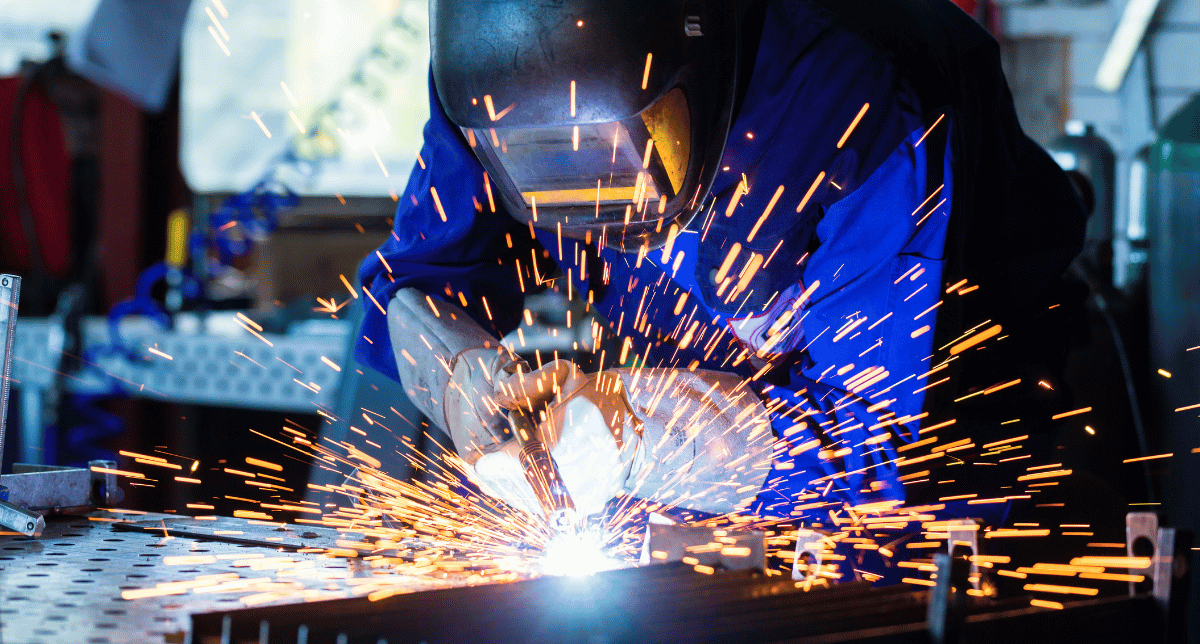
Operators received live weld quality predictions along with the interpretable reasons behind them, enabling immediate action to prevent defects rather than reacting after the fact.
The control tower view surfaced root causes, including underperforming crews, degrading machine components, and recurring conditions, that had previously gone undetected, turning weekly reviews into a driver of continuous improvement.
.png)
The measurable business results were significant enough that several client-side managers were promoted as a result of the improvement.
Key Takeaways
By translating fragmented sensor, metallurgical, and operational data into predictions delivered at the moment of decision, Aimpoint Digital helped a steel manufacturer turn a costly, opaque quality problem into a measurable, managed one. The solution did not just reduce waste; it gave the organization a durable capability to see, understand, and act on the drivers of quality across the plant floor.
Related case studies
.png)


Let's talk AI & data. We'll architect what's next.
Whether you need advanced AI solutions, strategic data expertise, or tailored insights, our team is here to help.