
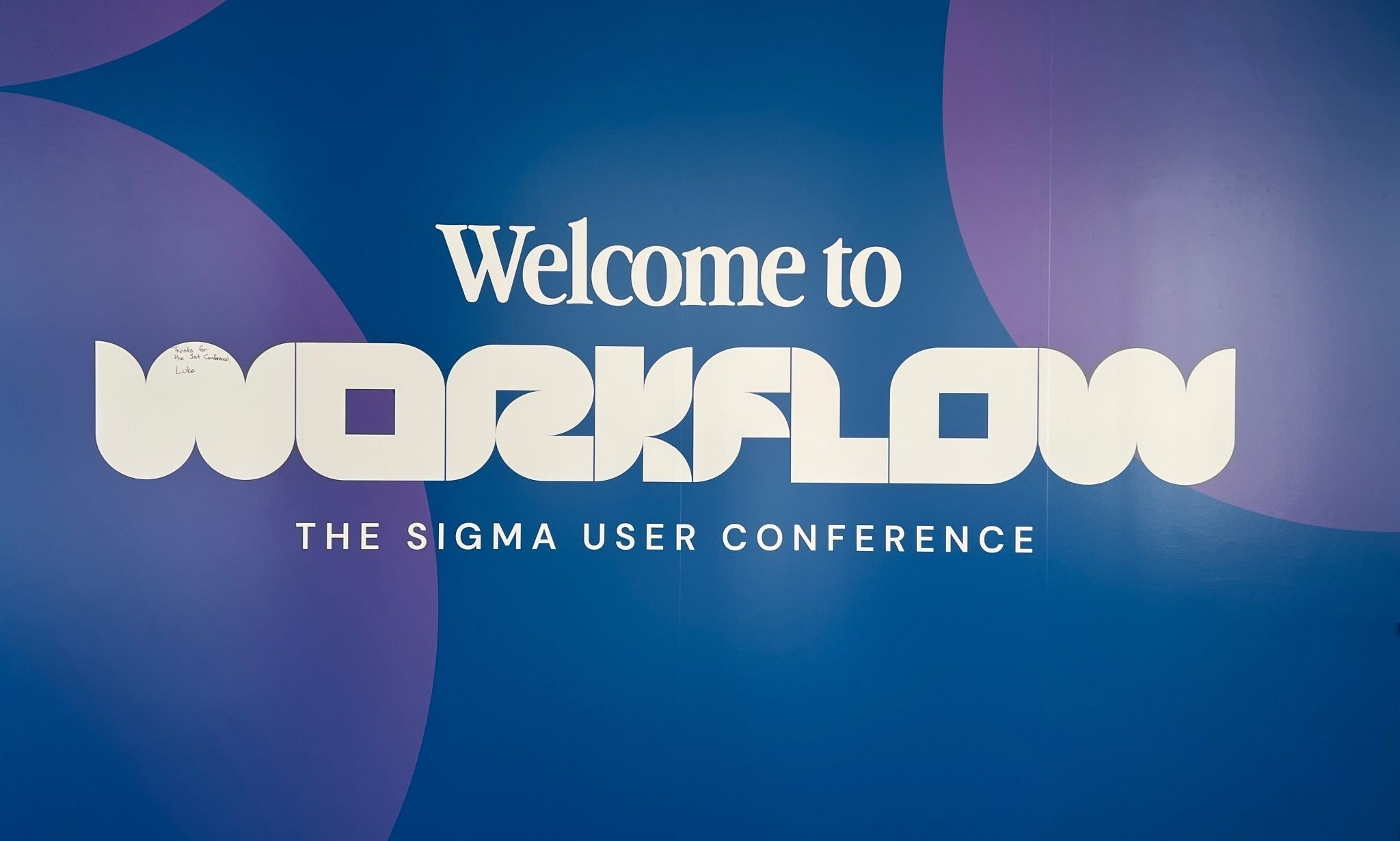
Last week, Sigma hosted its first in-person conference in San Francisco. Workflow brought together Sigma customers, partners, and the Sigma team for a full day of sessions and networking focused on the future of AI applications, conversational AI, and operational analytics.
For us, it was a great opportunity to connect with other builders in the Sigma community and swap ideas, see what’s new and upcoming in Sigma, and learn how others are using Sigma for their own business workflows.
Upcoming Feature Announcements
The keynote introduced several upcoming features that we’re particularly excited about. One of the biggest announcements was Sigma Tables, an evolution of input tables that will live at the account level rather than inside a single workbook. This means writeback tables can be shared and updated across multiple workbooks and apps without the workarounds many teams rely on today. For teams building applications in Sigma, this unlocks a much cleaner way to manage writeback data and makes it easier to scale operational workflows across the platform.
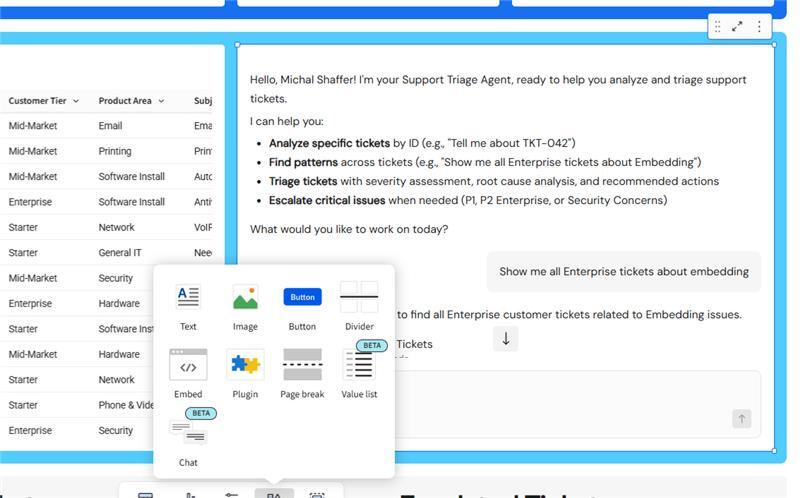
Unsurprisingly, AI was a major theme throughout the conference. One upcoming capability is a chat element that can be added directly into a workbook, allowing users to ask questions about their data in natural language. The chat element can be connected to specific data models and tables, so users can interact with the data conversationally while the chat analyzes the connected dataset.
Sigma also introduced AI agents that can be configured with specific instructions and access to defined datasets. These agents can assist users in exploring and understanding data within workbooks and apps. We were also introduced to what Sigma humorously called “agentception.” During the agent setup process, a built-in chat assistant helps generate and refine prompts, essentially using AI to help configure the AI agent itself. Future support for external MCP servers will also allow organizations to bring in agents created outside of Sigma and connect them to the data inside their applications.
Another feature we’re looking forward to is Sigma Public, an upcoming environment where users will be able to explore and interact with publicly shared Sigma applications. It will give people a chance to see real examples of what’s possible, experiment with apps, and gather ideas for what they might build themselves.

Builder Sessions and Workshops
Workflow also included builder sessions, hands-on workshops ranging from beginner to advanced levels. These sessions were all about learning by doing, giving us the chance to actually build in Sigma while trying out new features and approaches.
Another particularly valuable session focused on best practices for building AI applications in Sigma and introduced a framework called BUILD. The framework breaks the process down into five steps: defining the Business objective, mapping the User path, modeling the Inputs needed for the application, designing the Look and feel of the experience, and iterating through the Development cycle. It was a helpful way to think through the process of designing and building AI-powered applications step by step.
Several sessions showed how organizations are already using Sigma in real workflows. DraftKings demonstrated multiple internal applications they’ve built that support operational decision-making across their teams.
Aimpoint Digital also presented on the main stage, where we shared several applications we’ve built internally in Sigma, including a certification tracker used to manage employee certifications and a feedback application designed to streamline internal feedback collection. We also demonstrated a customer solution built with Extreme Networks: a Unified Analytics and Decision Hub built entirely in Sigma. The application combines live data with Cortex-powered Sigma-GPT, allowing users to explore data, surface insights, and support decision-making directly within the platform.
Build Challenge
One of the most entertaining moments of the event was the Build Challenge. Three Sigma power users competed live on stage, building solutions in Sigma in just 25 minutes. Watching experienced builders create working applications in real time was impressive and surprisingly fun to watch, with Lynda Chao ultimately taking home the win.
Outside of the sessions, the conference had great energy throughout the day. It was easy to start conversations with other Sigma users, compare notes on what people are building, and hear how different teams are approaching AI apps. Breakfast, lunch, snacks, and happy hour kept everyone well fed throughout the event, and the swag station was stocked with shirts, sweatshirts, bags, and other takeaways. One item that quickly became a favorite was the Lego cable car set, which many of us were excited to build and display afterward.
Final Takeaways
Workflow made it clear how quickly the platform is evolving into a place where analytics and operational workflows come together. We’re excited to see how these new capabilities continue to expand what teams can build in Sigma.
Move faster from insight to action with Sigma and Aimpoint Digital.
As a market-leading Sigma partner, Aimpoint Digital helps organizations go beyond dashboards to build governed, scalable AI applications that embed insights directly into workflows. We provide strategic advisory, implementation, and enablement to maximize impact from your modern AI analytics investment.
Learn more now or meet with an expert.

.png)
