Supply chain volatility and disruptions are no longer one-off temporary events. They are inherent in the modern operating environment. Geopolitical uncertainty, regulatory changes, and evolving trade relationships continue to reshape how supply chains operate, often with little warning. Organizations that can model these networks accurately, optimize across the network, and run scenarios quickly outperform those still relying on planning approaches built on fixed rules, spreadsheets, and expert-driven decisions. While effective in stable environments, these tools break down when their underlying assumptions change frequently and unpredictably.
We are pleased to announce Aimpoint Digital’s Supply Chain Intelligence (ASCI), our Databricks Brickbuilder Solution that applies mathematical optimization and AI to supply chain decision-making. Built on the Databricks Data Intelligence Platform, our Supply Chain Intelligence solution allows:
- Making faster, more confident supply chain decisions in volatile environments
- Evaluating sourcing, production, inventory, and transportation tradeoffs across the full network
- Comparing what-if scenarios before making costly operational changes
- Balancing tariffs, capacity, service levels, and total cost in a single model
- Generating scenarios from a plain-language description, and detecting disruptions automatically from a connected inbox or event feed
- Reducing reliance on spreadsheets, policy-based planning, and static rules
{{blog-carrousel}}
Why Heuristic Planning Breaks Down Under Real-World Supply Chain Complexity
When tariff structures change, supply chain teams do not evaluate tariff cost in isolation. In practice, they work to balance tariffs alongside production costs, transportation, capacity limits, inventory positions, and service requirements. The challenge is that most planning processes still rely on rules, spreadsheets, and expert judgment to manage these tradeoffs. Those methods can be effective, but as the complexity of the supply chain grows, they become harder to scale, slower to update, and more likely to miss counterintuitive opportunities.
A route that appears unattractive because of higher tariffs may still be the best choice once total landed cost, plant utilization, transportation economics, and downstream inventory effects are considered. In a large network, these tradeoffs play out across thousands of products, facilities, and lanes simultaneously. Even highly capable planning teams are often forced to simplify the problem in order to make decisions on time.
In our engagement with a global manufacturer responding to new regional tariff structures, their policy-based planning successfully reduced tariff costs but increased production expenses substantially. The mathematically optimized solution developed with our Supply Chain Intelligence solution selectively maintained certain high-tariff routes, specifically for products where total cost analysis justified their use and achieved superior performance across the complete cost structure.
This distinction illustrates the fundamental difference between rules-based manual planning and Aimpoint Digital’s Supply Chain Intelligence solution that can effectively choose between millions of possibilities with mathematical optimization.
ASCI Methodology: Scenario-Based Optimization
ASCI uses a structured approach centered on comparative scenario analysis, so you can evaluate trade-offs and make more informed decisions.
- How does the optimization engine balance competing costs?
The optimization engine, powered by Mixed-Integer Linear Programming, evaluates scenarios against comprehensive solution spaces comprising millions of potential configurations. The system balances transportation costs, production constraints, inventory requirements, and tariff obligations simultaneously, identifying solutions that optimize total network performance rather than individual cost components - Can business users query scenarios in plain language?
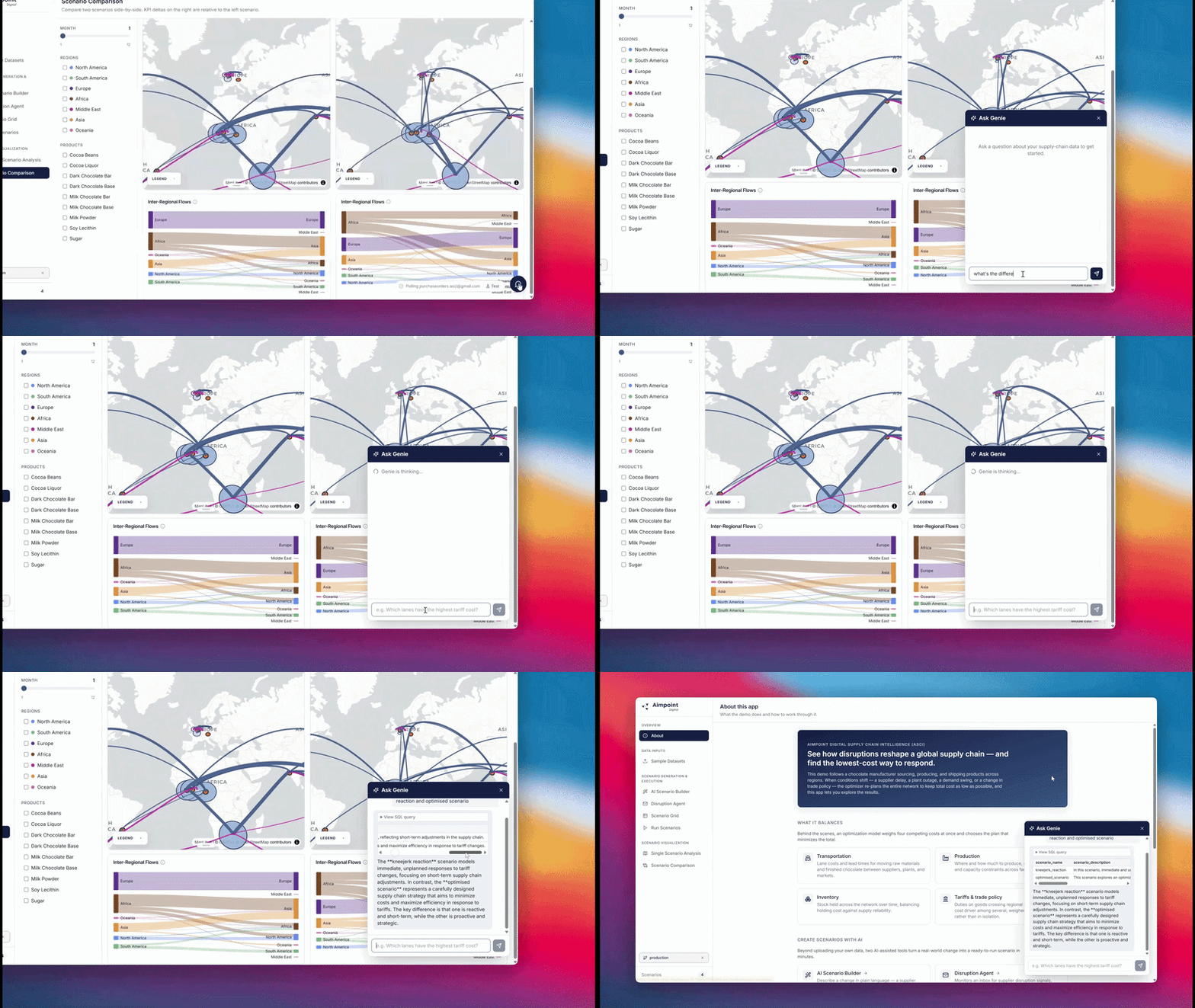
ASCI includes an integrated AI-powered interface enabling natural language queries against scenario data. Users can ask questions such as "What drives cost differences between scenarios?" and "Which facilities operate at highest utilization?", and receive data-driven responses without requiring technical expertise in optimization or database query languages - Can AI build the scenario itself?
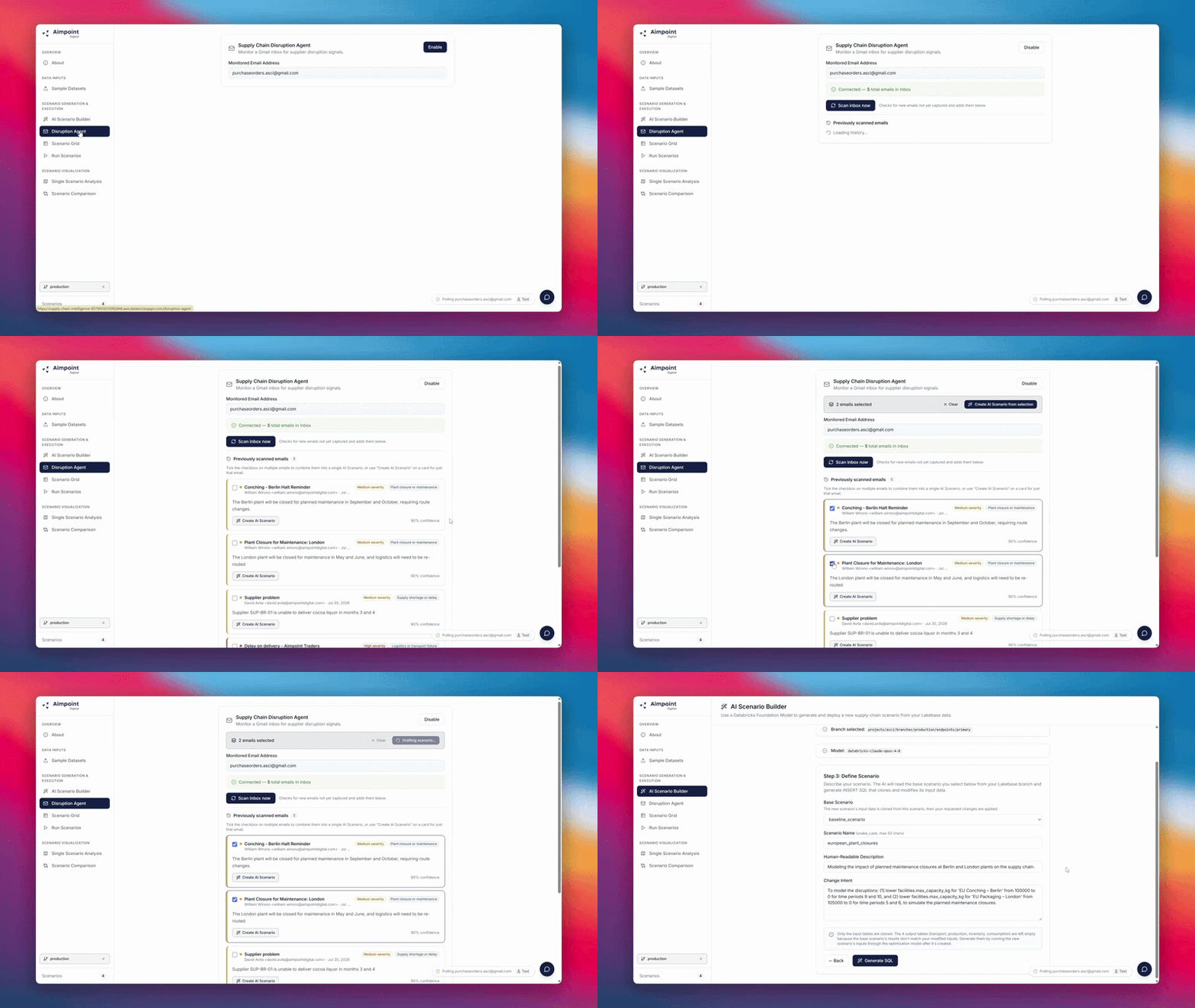
Yes, you can describe a change in plain language and the AI Scenario Builder generates the scenario for you. A Databricks Foundation Model grounded in live table schemas and validated examples produces reviewable INSERT and SELECT statements off a known-good baseline, each surfaced for a planner to approve before it runs. Approved scenarios execute in an isolated Lakebase branch and commit transactionally, so a multi-day analyst request becomes a self-service workflow measured in minutes, and production data is never altered by an unreviewed change - How do you detect a disruption before it reaches the plan?
ASCI includes a Disruption Agent that polls a connected inbox or RSS feed, reads each incoming message to detect events such as order delays, supply shortages, and disruptive public events, and classifies them. It identifies the affected parts of the network and drafts a matching what-if scenario grounded in your data, ready to run in the Scenario Builder. Planning shifts from reacting after the disruption lands to modeling the response while it is still developing - How do you test strategies before committing to them?
Users create multiple scenarios representing different strategic responses to market conditions. Existing operational plans to establish baseline performance, and new scenarios to test strategic alternatives, such as production reallocation, route consolidation, inventory repositioning, or combined approaches. Every scenario is versioned, so comparisons hold up over time and become institutional knowledge rather than a one-off analysis - What do the network visualizations actually show?
Interactive Sankey diagrams and network topology maps display material and product flows throughout the supply chain. Volume patterns, capacity utilization, and route efficiency become immediately apparent. Side-by-side scenario comparison reveals how strategic alternatives reshape operational configurations - What data do I need to get started?
Organizations integrate their supply chain data through flexible schemas that accommodate their existing Databricks infrastructure. Demand forecasts, facility specifications, supplier information, product configurations, and tariff structures integrate without requiring extensive data transformation or standardization
Built on Databricks: Production-Ready from Day One
ASCI runs entirely inside your Databricks environment. Spark Declarative Pipelines ingest, standardize, and validate source data into a curated planning model of Delta tables covering suppliers, plants, lanes, products, demand, and tariffs. Unity Catalog provides governance, lineage, access control, and audit history across data, scenarios, and results. Lakebase carries scenario branching and version control, so every baseline and alternative is stored, compared, and committed transactionally without duplicating datasets or touching production. The optimization engine runs as Python services calling Gurobi, and the planner-facing workflow, network views, and cost analysis run as a Databricks App. AI/BI Genie powers the conversational interface over scenario results.
The result is a solution that operates within existing Lakehouse architectures rather than creating isolated data systems or introducing governance complexity, with enterprise-grade scalability, native support for complex data transformations, and integration with the AI infrastructure already in place.
Demonstrated Results Across Industries
Aimpoint Digital has deployed supply chain optimization solutions across multiple sectors, including:
- ~30% reduction in safety stock while improving service levels. Multi-echelon inventory optimization for a global retail and CPG distribution network, replacing static inventory rules and fixed buffers with optimized sourcing, shipment, and safety stock decisions.
- 5 to 10% lower logistics costs, with faster and more consistent planning. Multi-stage production and distribution optimization across a global agricultural logistics network, evaluating production and logistics decisions together rather than in sequence.
- 10M reduction in cost by streamlining supply, facility, and demand markets. End-to-end transportation and refinery operations optimization for global energy operations.
These engagements demonstrate consistent patterns: organizations transitioning from heuristic planning to mathematical optimization achieve measurable total cost improvements, accelerated decision cycles, and increased confidence in pursuing strategies that deliver superior analytical performance.
A Databricks Brickbuilder Solution for Faster Supply Chain Decisions
Databricks Brickbuilder Solutions are partner-developed, end-to-end solutions built on the Databricks Data Intelligence Platform to help organizations move faster on high-value business use cases. Rather than starting from scratch, companies get a production-ready foundation that combines proven implementation experience, pre-built components, and the services needed to deploy and scale in an enterprise environment. For supply chain teams, that means a faster path from fragmented operational data to scenario modeling, optimization, and decision support in a governed Databricks environment.
Ready to Optimize Your Supply Chain?
Aimpoint Digital’s Supply Chain Intelligence is available as a Databricks Brickbuilder Solution. To learn more about applying mathematical optimization to supply chain decision-making, visit www.aimpointdigital.com/supply-chain-intelligence or contact our Applied Optimization and Simulation practice.


It operates through different phases, each with its own set of rules and implications

.png)