A year or two ago, many organizations were still debating where AI fit into the enterprise. This year, that debate has largely moved on. Instead, most leaders we spoke with were asking how to make sense of the growing number of AI tools already inside their business, how to govern them, and how to turn experimentation into repeatable value. Ultimately, they were asking how to operate AI well.
The next phase of enterprise AI will not be won by the organizations with the most tools or the most proofs of concept. It will be won by the organizations that know where each tool fits, how those tools integrate into existing business workflows, operational processes, and analytics experiences, how to ground AI in trusted business context, and how to govern and accelerate the path from experimentation to production.
This message aligns closely with the “4 Cs” Databricks emphasized at Summit: control, context, cost, and choice. As AI becomes more deeply embedded across analytics, engineering, and business workflows, these four dimensions are becoming the foundation for enterprise AI at scale.
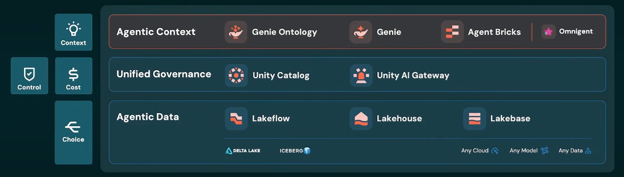
Across those dimensions, several consistent themes emerged from our conversations with leaders. Below, we unpack what we heard and share our perspective on what it means for organizations looking to scale AI responsibly.
AI Tool Sprawl Is Becoming an Operating Challenge
One of the most consistent themes we continue to hear from clients is not about a single product announcement. It was about confusion.
Many organizations now have Databricks Genie, Claude, ChatGPT, Copilot, and/or other AI assistants available internally. Some teams are seeing real productivity gains. Others are still trying to understand where these tools create value, where they introduce risk, and how they should coexist. In some cases, leaders are spending significant dollars on AI tooling while still describing the strategy as “throwing everything at the wall and seeing what sticks.”
That captures where many enterprises are today. AI adoption is spreading faster than AI operating models, creating a practical decision problem for executives. When should a business user ask a question in Claude or ChatGPT versus Databricks Genie? Why use Claude directly if Claude can already be accessed within Databricks, and when does the reverse make sense? When should an organization build a custom production agent through Mosaic AI and govern it through Unity AI Gateway?
There are a few distinct ways organizations can use these capabilities.
Claude or ChatGPT can be used directly for general-purpose productivity, research, writing, summarization, and other individual knowledge work. Those same models can also be accessed through Databricks, bringing them closer to enterprise data and workflows while benefiting from platform-level controls, monitoring, evaluation, and guardrails. Databricks Genie provides a natural-language interface to governed enterprise data and metrics, while custom solutions built with Mosaic AI can support more specialized production workflows and agents. Organizations may also choose to fine-tune or otherwise specialize models for specific business needs.
The point is not necessarily to choose one option over another. Increasingly, these capabilities can work together, with different tools operating at different layers of the stack.
The executive challenge is to move beyond giving teams access to AI tools. Organizations need a clear framework for how these capabilities fit together, what controls are required, and how value will be measured. Just as importantly, the framework needs to evolve as model capabilities, tooling options, and pricing change. Given how quickly AI is evolving, the best option for a task today may not be the best option next month.
Governance Is Moving from Data Access to AI Behavior
For years, data governance focused on access, lineage, quality, and reporting consistency. Those foundations still matter, but AI changes the scope.
As AI systems move from answering questions to writing code, calling tools, triggering workflows, and assisting with decisions, organizations need to govern not only what data AI can access, but also what actions it can take and how its behavior is monitored.
We heard this concern repeatedly in conversations at Summit, especially as AI coding tools make it easier for both technical and non-technical users to create applications. One company described seeing hundreds of AI-created applications emerge within weeks after opening up app-building capabilities to business users. The speed was exciting, but it quickly exposed the governance questions many organizations are now facing: who owns these applications, what data do they access, how are costs monitored, how are prompts and tool calls logged, how are outputs evaluated, and how are security risks such as SQL injection or unsafe data handling identified before these applications are used broadly?
This is where Unity AI Gateway and Omnigent become important beyond their immediate product capabilities. Unity AI Gateway allows organizations to centrally manage policies, usage, observability, spend controls, and access patterns across AI systems. Omnigent points to a future where AI coding workflows can be managed more intentionally across multiple coding assistants and model providers, rather than leaving each team or developer to operate in isolation.
The strategic theme is clear: governance is moving from passive oversight to active control. The companies that move fastest and generate the most value will not be the ones with no guardrails. They will be the ones with the right guardrails.
Semantic Layer Is the Key Foundation for Enterprise AI
Another major insight from Summit was how much the semantic layer conversation has matured. In the past, many organizations still needed to be convinced that a semantic layer mattered. Today, that conversation has changed. Leaders are increasingly asking how to implement a semantic layer for both BI and AI, not why they need one in the first place. More specifically, they wanted to know which assets to prioritize first, which use cases to build around, and how to keep definitions, metrics, and business context current after the initial implementation.
The shift is an important signal. The semantic layer is becoming more than a passive governance artifact or a reference point for consistent reporting. Its role is expanding into an active, strategic asset for AI-powered analytics: a shared context layer that helps humans, dashboards, chat interfaces, and agents work from the same trusted business definitions, logic, and source of truth across the entire analytics estate. Enterprise AI is only as useful as the context it can access. Without trusted definitions, governed metrics, domain ownership, and curated business knowledge, AI systems can generate answers quickly but inconsistently. They may be fluent, but not necessarily reliable.
We have written previously about the importance of an AI-ready semantic layer and how organizations can begin building one. Summit reinforced that this is no longer a niche data modeling concern. It is becoming central to enterprise AI strategy.
Databricks Ontology Could Redefine How Enterprises Provide AI Context
Genie Ontology was one of the most discussed announcements at Summit, and for good reason. One of the hardest problems in enterprise AI is helping agents understand which information is relevant, trusted, current, and safe to use.
Ontology is designed to give Databricks agents a structured map of the business context they need to answer questions well. It connects business terms, metrics, tables, dashboards, owners, lineage, and other knowledge sources so the agent can use that context directly when deciding how to respond. For example, if a user asks about revenue, churn, or customer growth, the agent can look to Ontology to understand which definition applies, which data assets are trusted, who owns them, how they relate to other concepts, and what business logic should guide the answer. If Databricks can make that experience work reliably, Ontology could make AI systems more accurate, useful, and aligned with how the business actually operates.
But the excitement also came with practical questions. If Ontology can surface and connect enterprise knowledge, how should organizations decide what belongs in that knowledge layer? How do they prevent development data, experimental metrics, or untrusted assets from influencing agent responses? How should teams prioritize Metric Views, Genie Agents, Domains, and Glossary pages as part of the broader semantic layer?
Our view is that Ontology does not eliminate the need for a well-designed semantic layer. It increases the importance of one. A strong ontology can make context more discoverable, but organizations still need to be intentional about the semantic assets it relies on: which metrics are certified, which domains are well-defined, which glossary terms are maintained, and which data products are ready for broader AI consumption.
In other words, Ontology may help agents find and connect enterprise knowledge more effectively, but it does not replace the foundational work of defining trusted metrics, curating business context, and establishing ownership across domains.
The Next Era of Self-Service Analytics Is Taking Shape
Another theme we heard was that more analytical work may start happening directly in Databricks, especially as AI-powered interfaces become more capable. In one conversation, a leader put the sentiment bluntly: he did not want his team creating a single new dashboard. The comment was intentionally provocative, but it captured a real shift in how leaders are thinking about analytics experiences.
That shift should not be interpreted as the end of dashboards. What is changing is the role dashboards play within the broader analytics experience. Rather than serving as the primary interface for every analytical question, they are increasingly becoming one component of a larger ecosystem. Dashboards remain valuable for monitoring and visually interpreting data, while conversational interfaces are becoming useful for exploration, follow-up questions, and ad-hoc analysis. Agents are emerging for deeper investigation, recommendation, and action. Deterministic workflows still matter for repeatable processes that require consistency and control.
This is where the promise of self-service analytics becomes more tangible. For years, organizations have aspired to give business users more direct access to data, but static dashboards alone could only take that experience so far. By augmenting dashboards with conversational and exploratory tools, organizations can help users move more naturally from “what happened?” to “why did it happen?” and “what should we do next?” without requiring every question to become a net-new reporting request.
The future is less likely to be “dashboards versus agents” and more likely to be an ecosystem where each interaction mode plays a role. A leader may start with a dashboard, ask a follow-up question in a chat interface, and then delegate deeper investigation to an agent. That agent may identify a driver, recommend an action, or create a visualization that becomes part of the standard reporting experience.
The executive implication is that BI strategy and AI strategy can no longer be treated as separate conversations. The same trusted metrics, governed data products, semantic definitions, and access controls need to support dashboards, chat experiences, agents, and the next generation of self-service analytics.
Closing Thought
Databricks Summit 2026 made one thing clear: the next phase of enterprise AI is about how organizations operate AI at scale. The "4 Cs" Databricks emphasized throughout the Summit—control, context, cost, and choice—offer a useful lens for thinking about what comes next.
Many organizations already have access to powerful AI tools. The leaders who succeed will be the ones connecting AI to trusted data, clear governance, scalable architecture, and real business workflows.
At Aimpoint Digital, we help organizations turn these themes into action: defining the right AI operating model, designing and implementing AI-ready semantic layers, modernizing analytics experiences, establishing governance patterns, and building production-grade solutions on platforms like Databricks.

.png)