When BI teams migrate between platforms, they often look for automations to reduce costs and minimize repetitive work. Before AI, that meant deterministic migration tools: rule-based engines that converted known source construct to its target equivalent. If your source dashboard rendered a bar chart with certain properties, the tool created an equivalent bar chart in the target platform. These tools are valuable because of their predictability. However, they require upfront development effort and aren’t well-suited for ambiguous migration tasks, meaning humans still needed to fill the gaps.
Newly released agentic AI tools promise a different, compelling approach: upload your file and get a working solution on the target platform, without human decision making needed even for the ambiguous tasks. Databricks’ new /importBI command from Genie Code is one of the latest examples of this. Users can upload a Tableau or Power BI file to Genie Code, which will then build any necessary metric views and an AI/BI dashboard. The appeal is obvious. BI migrations have historically been slow, labor-intensive, and expensive, so any technology that promises to compress that timeline deserves attention.
In many ways, this is the BI migration equivalent of vibe coding. We might even call it vibe migrating: letting an AI infer intent and assemble a target solution rather than explicitly specifying how every component should be translated. Just as vibe coding can rapidly produce a working application from a prompt, these tools can quickly produce what appears to be a successful migration. It is an impressive demonstration of what is possible, but producing something that works in a demo is not the same as producing something that is production ready.
The gap between those two things is that these tools automate two things at once. The labor of a migration, which you want automated, and the judgment inside it, which you may not. That second category is where the trade-off lives, and the trade-off is non-determinism: a deterministic tool given the same input twice produces the same output twice, while an agentic tool makes no such guarantee.
Handing non-deterministic reasoning a component that already has a known, testable mapping creates variability you didn’t need, along with the validation overhead and inconsistency that come with it. Forcing deterministic rules onto components that genuinely require interpretation produces brittle or incomplete migrations. Deciding which components warrant agentic migration, and which don’t, is the question that migration planning should start with.
Deciding which components warrant agentic migration, and which don’t, is the question that migration planning should start with.
Agentic vs. Deterministic Migration Trade-offs
When you default to an agentic approach across the board, you are accepting a specific set of trade-offs applied across every component, including pieces that don’t necessarily need AI. Recognizing this distinction is critical because there are trade-offs to each approach, and they compound when running a migration across hundreds or even thousands of solutions.
Trade-off #1: Cost
Agentic migrations can be cheaper to build, more expensive to scale
- Build: the cost to create the migration logic
- Run: the cost to execute it across the portfolio
- Validate: the cost to confirm each output is correct
- Rework: the cost to fix whatever comes back wrong
Neither approach will fully eliminate these costs. Each shifts them between fixed and variable.
A deterministic migrator is mostly upfront fixed cost. Every mapping gets specified and tested before the first asset runs. Once a rule exists, executing it against the thousandth asset costs effectively nothing.
An agentic migrator minimizes the upfront investment. This is what many AI demos showcase: craft a strong prompt (potentially augmented by a skills file), point your AI model at the workflows, and immediately start receiving output. The trade-off doesn’t emerge until you run that process at scale, where the cost arrives per asset in three areas.
- Token Cost: Every file processed by an AI-powered migrator carries a token cost. For simple workflows that cost is small, but it grows quickly for complex ones that require multi-pass processing, sub-agent architectures, or careful context management to avoid truncation.
- Re-derivation: Unlike deterministic logic, which captures knowledge once and reuses it indefinitely, an agent repeatedly re-derives that same understanding for every workflow it processes. It solves the same class of problem over and over, consuming tokens each time. As the number of files and workflows grows, those per-execution costs compound.
- Engineering Effort: As teams push for more consistent output from agentic migrators, they invest in better prompts, richer context management, sub-agent orchestration, and error handling. That effort scales with the variety of the portfolio, and it can approach what it would have taken to build deterministic mappings in the first place, except the resulting system is still probabilistic. The development savings that justified the agentic approach begin to disappear.

For smaller migrations, minimizing upfront development time may easily outweigh higher execution costs or additional validation effort. But as migrations grow from dozens of assets to hundreds or thousands, the economics shift. Costs that were negligible on a handful of workflows begin to compound across the entire portfolio.
Trade-off #2: Validation
Validation effort doesn’t disappear, it gets moved to the long tail of migrated assets
This is the trade-off that is least visible in a demo and most painful in practice.
A deterministic rule gets validated once. If it produces correct output for your test cases, it produces correct output for every file it touches. Validation is built into the rule and front-loaded into the build, so QA effort doesn’t grow as the portfolio grows.
Agentic migration works differently. Because the output is non-deterministic, every file becomes a new decision that has to be checked. The migrator can hallucinate a mapping that doesn’t exist, or carry logic forward from a previously processed file when context isn’t managed carefully. Output quality depends not only on the source asset, but also on prompt design, skills, context management, and model behavior across hundreds or thousands of runs.
That cumulative verification effort is the validation tax, and it is what you pay for not investing upfront in determinism. At small scale this tax is manageable, but at larger scale it can consume most of the time the automation was supposed to save.
Agentic migration doesn’t remove the upfront development effort altogether. It redistributes it across every generated asset someone has to validate, check, and potentially correct.
Trade-off #3: Consistency
Inconsistent output seeds a trust problem, which ultimately influences adoption
Any time a solution is converted, someone will need to pick up the migrated solution, understand what has changed, and operate it going forward.
Deterministic transformations are teachable. Every instance of X became Y, and here is the pattern. You can train users on it, document it, and audit against it.
When transformations are agentic, the conversion varies along several axes at once: different naming conventions, inconsistent layout and structural choices, or similar logic and calculations interpreted differently.
That inconsistency makes it harder to train users, harder to audit results, and hardest of all to build the trust required to get users to fully adopt the migrated environment. Users who don’t trust what they have been handed won’t use it, and that is how a migration ends up with a team rebuilding assets by hand, incurring the very costs the agentic migration was intended to prevent.
Taken together, the three trade-offs describe the same set of costs distributed two different ways.
Where AI Belongs in Migrations
AI should be used in BI migrations deliberately, with a clear understanding of where it adds value. It is best suited to the places deterministic rules fall short: where the mapping is ambiguous, where intent must be interpreted rather than translated, or where a rules-based approach would be so brittle or complex that the maintenance cost outweighs the benefit of determinism.
Everywhere else, deterministic solutions should be the default. Applied this way, AI shows up in well-defined, bounded, thoroughly tested components where deterministic solutions weren’t possible, and the migration stays cheaper to run, easier to validate, consistent, and auditable.
Consider the following matrix to decide between agentic and deterministic approaches, based on two variables – how clear the mapping is, and how often the component appears:
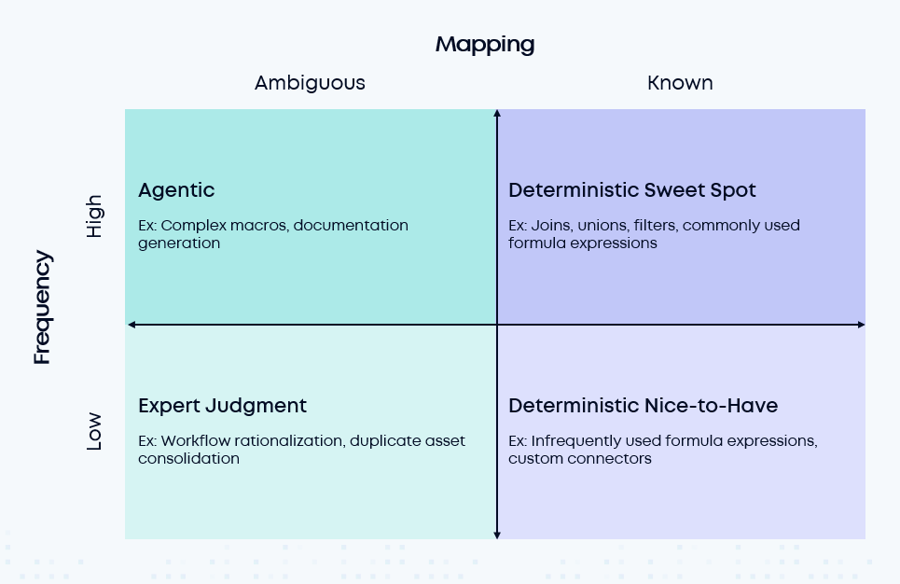
- Deterministic sweet spot (known mapping, high frequency): Joins, unions, filters, commonly used formula expressions. Clear equivalents and high volume, so the rule pays for itself many times over.
- Deterministic nice-to-have (known mapping, low frequency): Infrequently used formula expressions, custom connectors. A rule would work, but the build cost may exceed the benefit when only a few assets need it.
- Agentic (ambiguous mapping, high frequency): Complex macros, documentation generation. No clean rule exists, and the volume justifies the effort of getting prompts, context, and guardrails right.
- Expert judgment (ambiguous mapping, low frequency): Workflow rationalization, duplicate asset consolidation. These are decisions, not automation problems.
What no AI migrator will decide for you
That last quadrant deserves more attention than it usually gets. A migration is one of the few moments an organization has a defensible reason to look hard at its BI estate: retire assets nobody opens, consolidate near-duplicates, and rebuild what survives around the target platform’s strengths rather than the source platform’s constraints.
No migrator makes that call for you. A whole-portfolio agentic tool ingests everything and emits everything, because that is what it was built to do. It has no opinion about whether an asset earned its place. Point it at an unrationalized estate and you pay tokens to rebuild assets you were going to delete, pay again to validate them, and carry the technical debt into the new platform.
A partner who can’t tell you what should be migrated deterministically vs. agentically hasn’t yet guided you to the optimal BI migration solution.
Five questions to consider
If you are evaluating an agentic migration solution from a SaaS or delivery partner, consider:
- Which components will be handled deterministically vs. agentically, and why?
- What is the per-asset cost across the full portfolio, not just a small sample?
- How will output be validated, and how does validation effort scale from 50 assets to 500 or 5,000?
- How will consistency in naming, structure, formatting, and logic be enforced across every asset migrated?
- Where does human judgment enter to identify consolidation and retirement opportunities in the estate?
Be intentional about where AI belongs in your BI migration
The question isn’t whether AI can migrate your assets. It is whether your migration approach is built on component-level decisions about where AI adds value and where determinism is the better tool, or whether you are taking a path that defaults to AI for everything.
Agentic reasoning is valuable where interpretation is genuinely required. For known, repeatable mappings, deterministic logic turns a recurring per-asset expense into a one-time engineering investment that becomes more valuable with every asset it processes.
A better way of designing migration solutions involves breaking down the work, matching the right mechanism to each component, and using the transition as an opportunity to rationalize what you carry forward into the new environment. A whole-portfolio agentic migrator skips that decomposition, and the cost of skipping it shows up in token spend, validation effort, inconsistent output, and technical debt that follows you to the new platform.
At Aimpoint Digital we run BI platform migrations end to end, from assessment through implementation and user enablement. A rapid assessment produces the breakdown described above: a component-level inventory of your portfolio, a deterministic-or-agentic decision on each category, and the cost model behind it. Rather than applying AI indiscriminately, we help clients determine where deterministic automation provides the strongest guarantees and where agentic AI can meaningfully accelerate delivery.
If you’re evaluating a BI platform migration, or exploring how AI can accelerate modernization without sacrificing quality, contact us to discuss your migration strategy and identify the approach that’s right for your organization.


.png)
.png)